

I wanted to know something simple:
Can ChatGPT actually build a useful business plan, or does it just produce something that sounds like a business plan?
So instead of asking it a generic question like “Give me 10 business ideas,” I gave it a business I could realistically understand and evaluate.
The business was an AI video content agency for small businesses.
The idea was simple: help businesses create short promotional videos, social media content and advertisements using AI tools, without requiring them to hire a full production team.
I asked ChatGPT to build the business plan from scratch.
It gave me everything I requested:
- Target market
- Customer persona
- Customer problem
- Solution
- Pricing
- Competitors
- Marketing strategy
- Revenue projections
- Startup costs
- 12-month plan
- Business risks
At first, the plan looked impressive.
But when I started looking at it like a business owner rather than a reader, I noticed several problems.
Some parts were useful.
Some were too generic.
And a few numbers looked much more confident than they should have been.
So I decided to go through the entire plan section by section.
Important: This isn’t a test of whether ChatGPT can write. Obviously, it can. But the real question is whether the information it produces is good enough to make real business decisions
The Business I Gave ChatGPT
For this experiment, let’s call the business AI Video Studio.
The business would help small businesses create short-form marketing videos using AI.
For example, a restaurant could pay the agency to create videos for Instagram and TikTok.
A real estate agent could order property videos.
A fashion business could request product advertisements.
A small online business could get promotional videos without hiring a videographer.
The initial target would be businesses that need regular content but don’t have the budget or expertise to produce it themselves.
I then asked ChatGPT:
“Create a complete business plan for an AI video content agency targeting small businesses in United State of American. Include the target market, customer persona, problem, solution, pricing, competitors, marketing strategy, revenue projections, startup costs, a 12-month plan and major risks.”
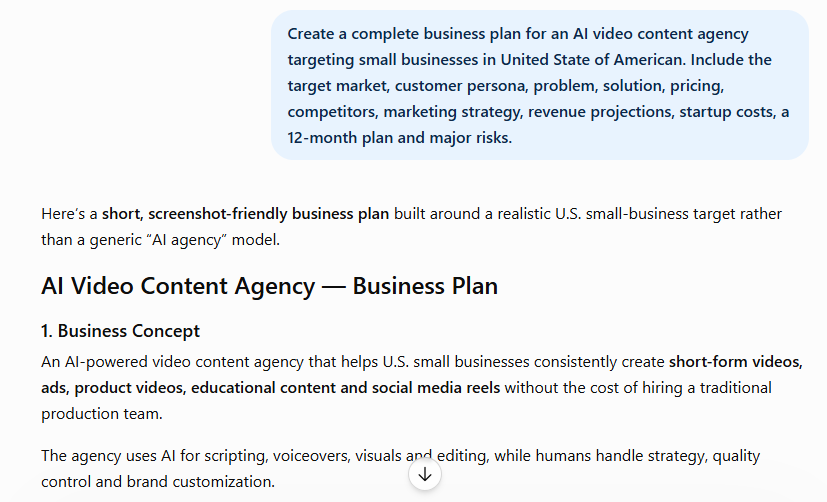
1. Target Market
ChatGPT said:
“The target customers are small and medium-sized businesses in U.S, particularly businesses that rely on social media marketing but lack the resources to produce professional video content consistently.”
That sounds reasonable.
And to be fair, I agreed with the general direction.
But there was a problem.
My response:
“Small businesses” is too broad.
A restaurant, real estate agent, fashion brand and software company may all be small businesses, but they don’t necessarily have the same problem.
More importantly, they don’t necessarily have the same willingness to pay.
If I were actually starting this business, I wouldn’t begin by saying:
“We serve small businesses.”
I’d narrow it down.
For example:
“We create short-form promotional videos for U.S real estate agents and property companies that need consistent social media content.”
That’s a much more specific market.
Now I know what kind of customer I’m looking for.
I know where they spend time.
I know what type of content they need.
And I can build an offer specifically around their problem.
What ChatGPT got right
It correctly identified businesses that need marketing content but may not have large production budgets.
What it got wrong
It treated a huge group of businesses as if they were one customer segment.
AI can identify a market category. It doesn’t automatically tell you which segment is most profitable for your particular business.
RECOMMENDED: I Asked AI to Generate 100 Best Startup Ideas – Here Are the 17 Startup Ideas Worth Building
2. Customer Persona
ChatGPT said:
“The ideal customer is a 28–45-year-old American business owner who uses Instagram, Facebook and TikTok to promote their business and wants affordable professional video content.”
Again, it sounded believable.
But where did those numbers come from?
Why 28–45?
Why would this person necessarily use all three platforms?
And why would they automatically want AI-generated videos?
My response:
This is one of the easiest things for AI to make sound convincing.
A customer persona can look extremely detailed while still being based on assumptions.
Instead of creating a persona from imagination, I’d rather interview 10–20 potential customers.
I’d ask questions such as:
- How do you currently create marketing videos?
- How much do you spend on content each month?
- What makes video production difficult?
- Which platform brings you customers?
- Have you ever paid someone to create videos for you?
- What did you dislike about the service?
- How much would you realistically pay for 10 videos?
Those answers are more valuable than a fictional customer called “David, age 34.”
My conclusion
ChatGPT’s persona was useful as a starting hypothesis, but I wouldn’t treat it as customer research.
That’s an important difference.
A persona generated by AI is not evidence that the person actually exists.
3. The Customer Problem
ChatGPT said:
“Small businesses struggle to consistently create high-quality video content because professional video production is expensive, time-consuming and requires specialized skills.”
This was probably the strongest part of the plan.
The problem is real.
But I still wanted to go deeper.
My response:
The question isn’t simply:
“Do businesses need videos?”
The better question is:
“Is this problem painful enough that they will pay me to solve it?”
Those are two completely different questions.
A business owner might agree that creating videos is difficult.
But they might still decide to:
- make videos themselves,
- use Canva,
- use CapCut,
- hire a freelancer,
- ask an employee to handle it,
- or simply post less frequently.
So the existence of a problem doesn’t automatically create a business opportunity.
The real test is willingness to pay.
4. The Solution
ChatGPT said:
“AI Video Studio will provide affordable AI-generated marketing videos, including social media advertisements, promotional videos, product videos and short-form content.”
It sounded good.
But there was something missing.
My response:
Why would a customer choose us instead of using AI tools themselves?
This is a major question.
AI video creation is becoming easier.
A business owner can potentially use ChatGPT, image generators, video generators, Canva, CapCut and other tools without hiring an agency.
So saying:
“We use AI to create videos.”
is not necessarily a strong competitive advantage.
The better offer would focus on the result, not the technology.
For example:
“We help real estate businesses turn their property listings into 12 social media videos every month.”
Now the customer isn’t buying “AI.”
They’re buying an outcome.
That distinction matters.
READ ALSO: I Built My Personal Website Using AI: Everything I Learned After Launching MrSixtus.com
5. Pricing
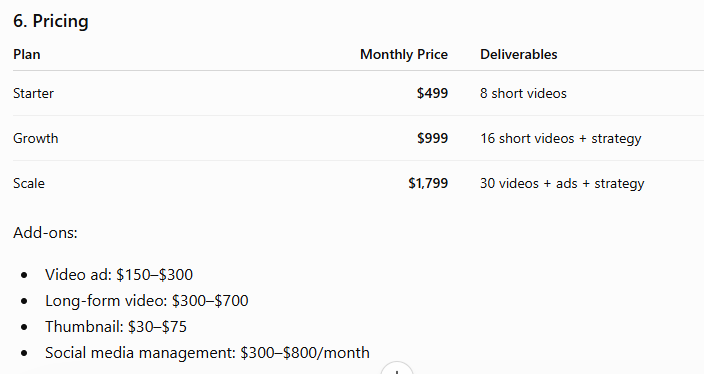
ChatGPT said:
“Basic Plan: $499/month
Standard Plan: $999/month
Premium Plan: $1,799/month.”
This was one of the sections I was most skeptical about.
The prices looked neat.
Almost too neat.
My response:
Where did these prices come from?
ChatGPT didn’t actually interview my customers.
It didn’t know my production costs.
It didn’t know how long each video would take.
It didn’t know how much U.S businesses in the chosen niche were already spending.
And it didn’t know whether customers would consider $499 cheap or expensive.
So these aren’t really validated prices.
They’re suggestions.
If I were launching the business, I’d test different offers instead.
For example:
Starter: 8 videos/month
Growth: 16 videos/month
Premium: 30 videos/month + strategy + revisions
Then I’d talk to potential customers and see which offer they actually want.
Pricing should come from a combination of:
customer value + production cost + market willingness to pay + positioning.
Not simply an AI-generated number.
6. Competitors
ChatGPT said:
“Key competitors include freelance video editors, traditional video production companies, social media agencies and DIY tools such as Canva and CapCut.”
This was directionally correct.
But it missed something important.
My response:
A competitor isn’t only another company selling exactly what you sell.
If my customer wants a promotional video, my competitors could include:
- a freelance editor,
- a photographer,
- a marketing agency,
- an employee,
- a friend who knows video editing,
- CapCut,
- Canva,
- or the business owner themselves.
The customer doesn’t care that my company is called an “AI video agency.”
They care about getting the job done.
This is why competitive research needs to start with the customer’s alternative, not just companies offering a similar service.
7. Marketing Strategy
ChatGPT said:
“Use social media marketing, content marketing, paid advertising, influencer partnerships, email marketing and referral programs to attract customers.”
This is where the plan started becoming very generic.
Basically:
Do everything.
My response:
A new business probably doesn’t have enough money, people or time to execute six marketing channels properly.
I’d rather choose one or two channels.
For this particular business, I’d start with direct outreach and content.
For example:
- Find 100 real estate businesses.
- Look at their existing social media content.
- Identify businesses with weak or inconsistent video content.
- Create one sample video for a few prospects.
- Send it directly to them.
- Offer a monthly content package.
- Track responses.
That gives me actual feedback.
If nobody responds, I can change the offer.
If people respond but say the price is too high, I can test pricing.
If they love the videos but don’t want monthly service, I can change the business model.
That’s more useful than simply writing:
“Use social media marketing.”
READ ALSO: My Entrepreneur Journey: The Late Nights, Hard Lessons, and Success Stories That Changed My Life
10. Revenue Projection
Assuming the average client eventually pays $1,000/month:
| Month | Clients | Monthly Revenue |
|---|---|---|
| 1 | 2 | $2,000 |
| 3 | 5 | $5,000 |
| 6 | 12 | $12,000 |
| 9 | 20 | $20,000 |
| 12 | 30 | $30,000 |
Potential Year-1 revenue: approximately $150,000–$200,000, depending on how quickly clients are acquired and retained.
9. Startup Costs
ChatGPT said:
“Initial startup costs could include a laptop, internet, AI software subscriptions, website development, branding and marketing.”
This was reasonable.
But once again, it was too broad.
My response:
For an AI-based service business, the biggest startup cost might not actually be software.
The bigger cost could be time.
For example, if I spend four hours producing each customer’s videos, getting 20 customers could create a serious capacity problem.
So I would calculate:
Cost per customer = software + human time + revisions + storage + internet + other operational costs.
Then I’d ask:
How many customers can one person realistically handle?
That’s a question ChatGPT’s original business plan didn’t answer well.
10. The 12-Month Plan
ChatGPT said:
The plan looked something like this:
Months 1–3: Build the brand and acquire the first customers.
Months 4–6: Increase marketing and expand the customer base.
Months 7–9: Hire staff and introduce new services.
Months 10–12: Scale the business and increase revenue.
It sounds like a proper business roadmap.
But there’s a problem.
My response:
What happens if the first customers don’t come?
A real business doesn’t move according to a perfectly predictable calendar.
I’d rather create a plan based on milestones.
For example:
Stage 1: Validate
Get 5 paying customers.
Stage 2: Prove retention
Keep at least 3–5 customers for three consecutive months.
Stage 3: Improve the system
Document the production process.
Stage 4: Scale
Only then consider hiring.
This is much safer than deciding in advance:
“Month seven: hire two employees.”
The business should earn the right to scale.
11. Business Risks
ChatGPT said:
“Major risks include increasing competition, changing AI technology, customer acquisition challenges, technical issues and changing customer preferences.”
This was correct.
But it was also predictable.
Almost every AI business plan could contain the same paragraph.
My response:
I wanted more specific risks.
For this business, I’d worry about things like:
AI quality: Some generated videos may look unrealistic or inconsistent.
Client expectations: Customers may expect unlimited revisions because they think AI makes everything easy.
Platform changes: Social media algorithms can change.
Tool dependency: An AI provider could increase prices or change its features.
Low switching costs: Customers could decide to learn the tools themselves.
Capacity: Too many clients could make production difficult.
Customer retention: A client may only need videos for a short campaign.
Those risks are much closer to the actual business.
READ ALSO: How AI Improved My Decision Making as a Founder: My Personal Experience
So, Was ChatGPT’s Business Plan Bad?
No.
That’s actually the interesting part.
The plan wasn’t useless.
It was a good starting point.
ChatGPT helped me organize my thoughts quickly.
It identified potential customers, problems, competitors, marketing channels and risks.
The problem is that many sections sounded more certain than the available evidence justified.
That’s the difference between:
“This is a possible business plan.”
and
“This business has been validated.”
They aren’t the same thing.
The Biggest Lesson I Learned
If you ask ChatGPT:
“Create a business plan for me.”
you will probably get a polished document.
But a polished document isn’t necessarily a good business.
AI is very good at turning assumptions into structured text.
That can be useful.
But it can also make weak assumptions look intelligent.
That’s why I would use ChatGPT differently.
Instead of asking:
“Tell me whether this business will succeed.”
I’d ask:
“Here is what I know about my market. What assumptions am I making that could be wrong?”
Then I’d validate those assumptions in the real world.
My Final Verdict
Would I use ChatGPT to create a business plan?
Yes.
Would I use the plan exactly as it was generated?
Absolutely not.
I’d treat it as a first draft.
The real work starts after the AI finishes writing.
You still need to:
- research the market,
- talk to customers,
- study competitors,
- test pricing,
- calculate your actual costs,
- try to sell,
- measure results,
- and change the plan when reality disagrees with your assumptions.
The most valuable thing ChatGPT gave me wasn’t a perfect business plan.
It gave me a starting point to question.
And perhaps that’s the better way to use AI for entrepreneurship:
Don’t ask AI to replace your business judgment. Use it to make your judgment better.







If you’re tired of guessing or making manual calculations, I鈥檝e found a great resource. Multiple Calculator offers a variety of accurate online tools that come with clear formulas, so you can trust the results. Whether you鈥檙e planning a budget, working on a DIY project, or just need quick math help, their calculators simplify the process. The examples and guidance provided make it even easier to use. Check it out at https://multiplecalculator.com/ for faster, smarter decisions.
I’ve been using Multiple Calculator for a while now, and it’s been a game-changer for quick, accurate calculations. Whether I’m budgeting, planning a project, or just solving everyday math problems, the clear inputs and visible formulas make it easy to trust the results. The best part? It’s completely free and doesn’t require any downloads.
If you’re tired of second-guessing your calculations, give it a shot. The site offers a variety of tools, all designed to simplify decision-making. Check it out at https://multiplecalculator.com/ and see how it can streamline your workflow. Highly recommend!