Being a founder means making decisions when you do not have all the information.
Should I build this product or leave it alone?
Should I spend money on marketing or improve the product first?
Should I launch now or wait?
Is this business idea actually worth pursuing?
Am I looking at a real opportunity, or am I simply excited about an idea?
I have faced questions like these many times.
For a long time, I thought good decision making was mostly about experience, intuition, research and confidence. I still believe those things matter. But AI has changed one important part of my process: how I think before I make the final decision.
I do not use AI to make every decision for me.
Instead, I use it to challenge my assumptions, organize information, explore alternatives and help me see problems from perspectives I might otherwise miss.
That is what AI decision making has become for me.
AI has not replaced my judgment as a founder. It has made the thinking behind that judgment more structured.
And in my experience, that difference can be surprisingly valuable.
The Problem I Had Before Using AI for Decision Making
One of the hardest things about building businesses is that founders rarely have the luxury of perfect information.
You might spend days researching an idea and still be unsure whether people actually want it.
You might have ten possible strategies and no obvious way to choose between them.
You might become emotionally attached to an idea because you created it yourself.
That last one was particularly important for me.

When you come up with a business idea, it is very easy to become its biggest supporter. You start looking for reasons why it will work instead of reasons why it might fail.
I realized that I needed something that could push back against my thinking.
That was where AI became useful.
Instead of asking AI:
“Is this a good business idea?”
I started asking much better questions.
For example:
- What assumptions am I making?
- What could make this business fail?
- What would a skeptical investor say about this idea?
- Who are the strongest competitors?
- What customer problem does this actually solve?
- What would have to be true for this business to succeed?
- What is the cheapest way to test the idea?
- What am I overlooking?
Those questions produced much more useful conversations.
RECOMMENDED: My Entrepreneur Journey: The Late Nights, Hard Lessons, and Success Stories That Changed My Life
AI Became My Second Opinion, Not My Boss
This is probably the biggest lesson I have learned about using AI as a founder.
I don’t want AI to make the decision. I want AI to improve the decision making process.
There is a major difference.
If I ask an AI model a question and blindly follow its answer, I have not necessarily become a better decision maker.
I have simply transferred the responsibility to a machine.
Instead, I treat AI more like a very fast brainstorming partner.
It can analyze an argument.
It can generate alternatives.
It can identify potential weaknesses.
It can help structure messy information.
It can simulate different scenarios.
But I still have to decide what matters.
That distinction is important because AI can be confidently wrong. It can misunderstand the context of a business, rely on incomplete information or produce an answer that sounds convincing but does not fit reality.
Recent research on AI and strategic decision-making also suggests that AI can augment how entrepreneurs search for and evaluate strategies, rather than eliminating the need for entrepreneurial judgment.
That is exactly how I have come to view it.
How AI Improved My Decision-Making as a Founder
The biggest improvement was not that I suddenly started making perfect decisions.
I didn’t.
The improvement was that I became more deliberate about how I arrived at a decision.
Here are some of the ways AI changed my process.
1. AI Helped Me Challenge My Own Ideas
Founders can become emotionally attached to their ideas.
When I am excited about a new project, my natural reaction is to think about how I can make it work.
AI gives me an opportunity to approach the same idea from the opposite direction.
I can ask:
“Give me the strongest reasons I should NOT build this.”
That question is incredibly useful.
Instead of receiving encouragement, I get a list of possible weaknesses.
Maybe the market is too crowded.
Maybe the problem is not painful enough.
Maybe the business model is difficult to monetize.
Maybe there is a simpler way to solve the same problem.
Maybe I am building something because I personally like it rather than because customers need it.
None of these answers automatically means I should abandon an idea.
But they give me questions that I need to investigate.
That alone can save a founder from wasting months building the wrong thing.
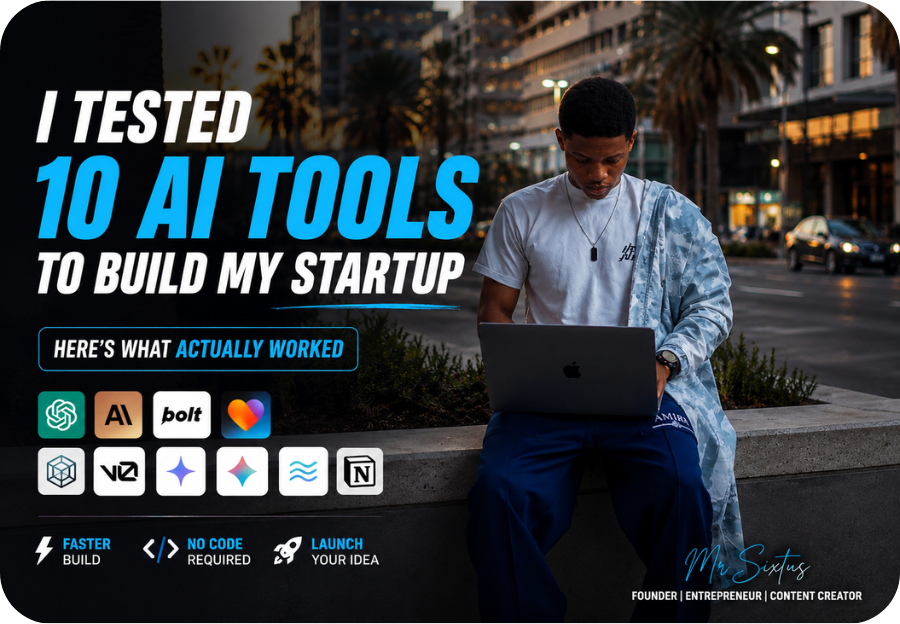
RECOMMENDED: I Tested 10 AI Tools to Build My Startup — Here’s What Actually Worked (And Why Lovable.dev Won)
2. AI Helped Me Compare Multiple Options
Another major improvement came from using AI when I had several options.
Previously, I might have compared two ideas based on instinct.
Now I can create a simple decision framework.
For example, I might ask AI to compare different opportunities based on:
| Factor | Question |
|---|---|
| Market demand | Is there a real problem to solve? |
| Competition | How difficult will it be to compete? |
| Cost | How expensive is the first version? |
| Speed | How quickly can I test it? |
| Monetization | How could the idea make money? |
| Distribution | How will customers discover it? |
| Scalability | Can it grow beyond my personal time? |
| Risk | What could cause the idea to fail? |
This does not give me a magical answer.
Instead, it forces me to think about the decision from multiple angles.
That is where I find AI tools for decision making particularly useful.
They can turn an emotional or complicated question into something I can actually analyze.
3. AI Helped Me Research Faster
Research is one of the biggest time-consuming activities for founders.
Before making a major decision, I may want to understand:
- competitors
- customers
- market trends
- pricing
- business models
- technology
- distribution channels
- potential risks
AI can help me organize this information much faster.
Instead of starting with a blank document, I can use AI to create a research framework.
For example:
“I am considering launching this product. Give me a research checklist covering market demand, competitors, pricing, customer pain points, distribution and major risks.”
Now I have a structure.
I can then research each section and use AI to help organize what I discover.
This distinction matters.
AI can accelerate research, but accelerated research is not automatically accurate research.
I still verify important facts using reliable sources before making significant business decisions.
READ ALSO: I Asked AI to Generate 100 Best Startup Ideas – Here Are the 17 Startup Ideas Worth Building
4. AI Helped Me See Different Perspectives
One of the most underrated benefits of AI decision making is perspective.
Sometimes I ask AI to analyze the same business decision from different viewpoints.
For example:
Think like a customer.
Then:
Think like a competitor.
Then:
Think like an investor.
Then:
Think like a founder with a limited budget.
The answers can expose completely different problems.
A customer might say the product is too complicated.
A competitor might have an easier distribution strategy.
An investor might question the market size.
A founder might realize the business requires too much capital.
Suddenly, one decision becomes several different conversations.
That gives me a more complete picture.
5. AI Reduced the Pressure of Making Decisions Alone
Being a founder can sometimes feel like making decisions inside your own head.
You have an idea.
You think about it.
You question it.
You come back to it.
Then you question it again.
Having AI available gives me somewhere to externalize that thinking.
I can write down the problem exactly as I see it.
Then I can ask AI to organize my thoughts.
Sometimes I discover that the problem was not as complicated as I initially thought.
Other times, I discover that I had not considered an important issue at all.
The value is not necessarily in the final AI response.
The value is often in the conversation that gets me to think more clearly.
The AI Tools I Use for Decision-Making
There is no single AI tool that makes every business decision better.
Different tools are useful for different parts of the process.
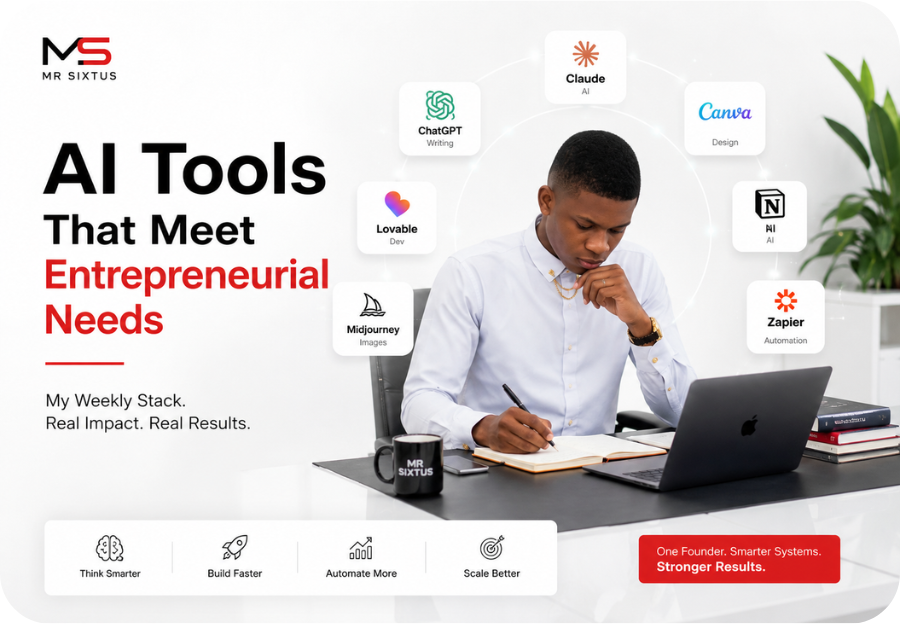
ChatGPT
I use ChatGPT primarily as a thinking partner.
It is useful for:
- brainstorming
- evaluating ideas
- creating decision frameworks
- identifying risks
- comparing strategies
- developing questions
- analyzing business models
- turning unstructured thoughts into structured plans
For me, this is one of the most practical applications of AI.
Perplexity
For research-heavy decisions, an AI search tool can be useful because it can help locate and summarize information from multiple sources.
That makes it useful when I need to investigate a market, competitor or topic before forming an opinion.
Claude
I also see value in AI assistants that are particularly useful for analyzing long documents, complex ideas and detailed context.
For founders, the important thing is not which tool is considered “the best.”
The better question is:
Which tool helps me answer the specific question I am facing?
Current founder-focused AI tool comparisons similarly show that different products are optimized for different jobs, from reasoning and research to coding, automation and strategy.
SEE ALSO: Gemini vs ChatGPT Which One Is Better? Complete 2026 Comparison Guide
My AI Decision Making Framework
Over time, I have developed a simple way of using AI when I face an important decision.
It looks like this:
Step 1: Define the decision
I start by writing down exactly what I am deciding.
Not:
“What should I do with this business?”
But:
“Should I spend the next 30 days developing this product or validating the market first?”
The more specific the question, the more useful the analysis becomes.
Step 2: Explain the context
I give AI the information it needs.
That can include:
- my objective
- available resources
- budget
- timeframe
- target audience
- current situation
- constraints
- alternatives
Without context, AI can only give generic advice.
Step 3: Ask for opposing arguments
This is one of my favorite steps.
I ask:
“What are the strongest arguments against this decision?”
This helps expose confirmation bias.
Step 4: Generate alternatives
I ask:
“What are three alternatives I haven’t considered?”
Sometimes the best decision is not Option A or Option B.
It is Option C.
Step 5: Identify the biggest uncertainty
I ask:
“What information would most change this decision?”
This is extremely important.
Instead of trying to research everything, I focus on the information that could actually change my mind.
Step 6: Make the decision myself
This is where the human comes back into the process.
After considering the information, I make the call.
AI can help me think.
I still own the decision.
RECOMMENDED: Best AI Prompts for Business: My 10 Killer AI Prompts Every Entrepreneur Should Save
What AI Has Not Changed About My Decision Making
Despite how useful AI has become, there are things I still refuse to outsource.
Experience
AI can analyze information, but it does not have my personal experience of building something.
Relationships
Business decisions sometimes involve people, trust and relationships.
Those cannot always be reduced to a prompt.
Values
AI does not know what I ultimately want my business or life to represent unless I tell it.
Even then, I have to decide whether its recommendation aligns with my values.
Accountability
If a decision fails, I cannot blame ChatGPT.
The responsibility remains mine.
That is why I think founders should be careful about becoming overly dependent on AI. Recent examples from business leaders show that excessive reliance on AI can sometimes create shallow analysis and poor follow-through when people stop applying sufficient human judgment.
AI should increase responsibility, not reduce it.
The Biggest Mistake Founders Can Make With AI
Ironically, the biggest mistake is probably asking AI for answers too quickly.
If you ask:
“Should I start this business?”
You may get an impressive answer.
But it might not be the right answer for you.
A better approach is to ask:
“Here is the business I am considering, the customer problem, my budget, my skills, my competitors and my goals. What assumptions am I making, what are the biggest risks, and what evidence should I collect before deciding whether to build it?”
That is a much better question.
The quality of your decision often depends on the quality of the problem you give AI.
Better questions produce better thinking.
AI Did Not Make Me a Better Founder Overnight
I want to make this clear because there is a lot of hype around AI.
Using AI does not suddenly make someone a great entrepreneur.
It does not give you customers.
It does not guarantee that your product will succeed.
It does not replace market validation.
And it certainly does not eliminate failure.
What it can do is reduce some of the friction around thinking.
For me, that means I can explore an idea faster, challenge my assumptions earlier and organize complicated decisions before taking action.
That is a meaningful advantage.
Research into entrepreneurial decision-making increasingly points toward the same general idea: AI can complement human expertise, while domain knowledge and human judgment remain important parts of entrepreneurial decision-making.
How Founders Can Start Using AI for Better Decisions
If you are a founder who has never used AI for strategic decisions, you do not need a complicated system.
Start with one decision.
Pick something you are currently struggling with.
Then give AI the context.
For example:
“I am a founder deciding whether to launch Product A or Product B. Here is my budget, target customer, current audience, competition and expected revenue. Do not simply tell me which one to choose. Analyze the assumptions behind each option, identify the biggest risks, compare the opportunities and tell me what additional information I should collect before making the decision.”
That is a much better use of AI than simply asking:
“Which product should I build?”
The first approach makes AI part of your thinking process.
The second makes AI responsible for your thinking.
There is a big difference.
My Biggest Lesson From Using AI for Decision Making
If I had to summarize my experience in one sentence, it would be this:
AI did not make my decisions for me; it helped me become more intentional about how I make them.
That has changed the way I approach business ideas, product decisions, research and strategy.
I still trust intuition.
I still listen to people.
I still do my own research.
I still make mistakes.
But now, before making an important decision, I have another way to challenge my thinking.
And sometimes, that extra perspective is exactly what a founder needs.
The future of entrepreneurship will probably not belong to founders who blindly follow AI.
It will belong to founders who know when to use AI, how to question it and when to ignore it.
That is how I currently think about AI decision making.
Not as a replacement for entrepreneurial judgment, but as a tool that can make that judgment more informed, structured and deliberate.
Final Thoughts
I used to think better decisions came mainly from having more experience.
Now I think they also come from having a better process.
AI has become part of that process for me.
It helps me slow down when I am too excited, challenge myself when I am too confident and structure my thinking when there are too many possibilities.
That does not mean I will always make the right decision.
It simply means I am less likely to make an important decision without questioning my own assumptions first.
And as a founder, I have learned that sometimes the quality of the question you ask before making a decision can be just as important as the decision itself...
Frequently Asked Questions About AI Decision Making
Can AI really improve decision making for founders?
Yes, when it is used as a decision-support tool rather than an authority. AI can help founders organize information, identify assumptions, compare alternatives, explore risks and generate different perspectives.
What are the best AI tools for decision making?
The best tool depends on the decision. General-purpose AI assistants such as ChatGPT and Claude can help with reasoning and analysis, while AI search tools such as Perplexity can be useful for research. Other specialized tools focus on finance, operations, strategy or automation.
Should founders let AI make business decisions?
I would not recommend blindly delegating important business decisions to AI. Founders should use AI to analyze options and challenge assumptions while retaining responsibility for the final decision.
How can I use AI to make better business decisions?
Start by clearly defining the decision, provide relevant context, ask AI to challenge your assumptions, explore alternative options, identify risks and determine what additional information you need. Then make the final decision yourself.
Can AI replace a business mentor or advisor?
Not completely. AI can provide fast analysis and different perspectives, but experienced mentors and advisors can contribute context, relationships, judgment and firsthand experience that AI does not possess.