Artificial Intelligence changed the way I work.
But before it transformed my business, it almost ruined it.
If you’re a solo entrepreneur searching for ways to use AI for My Business, this story might save you months of frustration, wasted money, and missed opportunities.
This Story Could Be Yours
When I started building my first minimum viable product (MVP), I had absolutely no business background.
I wasn’t an MBA graduate.
I had never raised venture capital.
I didn’t have a mentor guiding every decision.
What I did have was curiosity, determination, and access to AI tools.
Like many first time founders, I believed AI could do everything.
I asked it to write my business plan.
I asked it to design my logo.
I generated my website with AI.
I wrote emails with AI.
I created blog posts.
Marketing plans.
Social media captions.
Sales pages.
Even my product roadmap.
Everything looked impressive.
Everything sounded professional.
Yet after weeks of work…
Nothing happened.
No customers.
No traction.
No meaningful feedback.
That was when I realised something important.
AI is an incredible assistant, but it is a terrible replacement for thinking like a founder.
That lesson completely changed how I build businesses today.
RECOMMENDED: My Entrepreneur Journey: The Late Nights, Hard Lessons, and Success Stories That Changed My Life
Why So Many Entrepreneurs Fail with AI
The problem isn’t AI.
The problem is expecting AI to replace experience, customer research, and strategic thinking.
Many entrepreneurs believe AI can build a successful company automatically.
It can’t.
AI accelerates good decisions.
It also accelerates bad ones.

The Biggest Mistakes I Made Using AI for My Business
1. I Let AI Make Every Decision
Instead of validating ideas myself, I accepted every suggestion AI generated.
It recommended features.
Pricing.
Business names.
Marketing channels.
Even target audiences.
And the result?
I built what AI thought people wanted, not what real people actually needed.
Lesson
Use AI to generate options.
Never allow it to make the final decision.
2. I Skipped Customer Research
I assumed AI already knew what customers wanted.
That was my biggest mistake.
AI learns from existing information.
Your future customers may have problems that no AI model can accurately predict.
Better Approach
Talk to real customers.
Read reviews.
Conduct surveys.
Study competitors.
Then ask AI to organise your findings.
3. I Published AI Content Without Editing
At first, every blog article sounded perfect.
Too perfect.
They all had the same predictable structure.
The same generic phrases.
The same polished but forgettable tone.
Eventually, I realised my content lacked personality.
Readers weren’t connecting with it.
Lesson
People remember stories.
Not perfectly structured paragraphs.
Always add your own experiences, opinions, and insights.
READ ALSO: I Built My Personal Website Using AI: Everything I Learned After Launching MrSixtus.com
4. I Trusted AI More Than Analytics
Whenever traffic dropped, I asked AI why.
Instead of checking Google Search Console or analytics data, I relied on AI’s assumptions.
AI can only work with the information you provide.
Without real data, it is simply guessing.
5. I Tried to Automate Every Task
Automation sounds exciting.
But automating a broken process only makes mistakes happen faster.
Before using AI, understand the process yourself.
Only automate tasks that already work.
6. I Ignored Branding
AI generated a beautiful logo.
A modern colour palette.
Professional fonts.
An elegant website.
Yet my brand had no identity.
Everything looked good but felt generic.
Customers couldn’t remember it.
Strong brands are built through consistent values, storytelling, and trust – not templates.
7. I Built Features Nobody Wanted
Every AI conversation produced ten exciting feature ideas.
I kept adding them.
Soon my simple MVP became a complicated product.
Ironically, users wanted fewer features.
Not more.
Lesson
Launch sooner.
Improve later.
8. I Forgot That Trust Cannot Be Automated
AI can write emails.
But it cannot build genuine relationships.
Customers buy from brands they trust.
That trust comes from consistency, honesty, and delivering value over time.
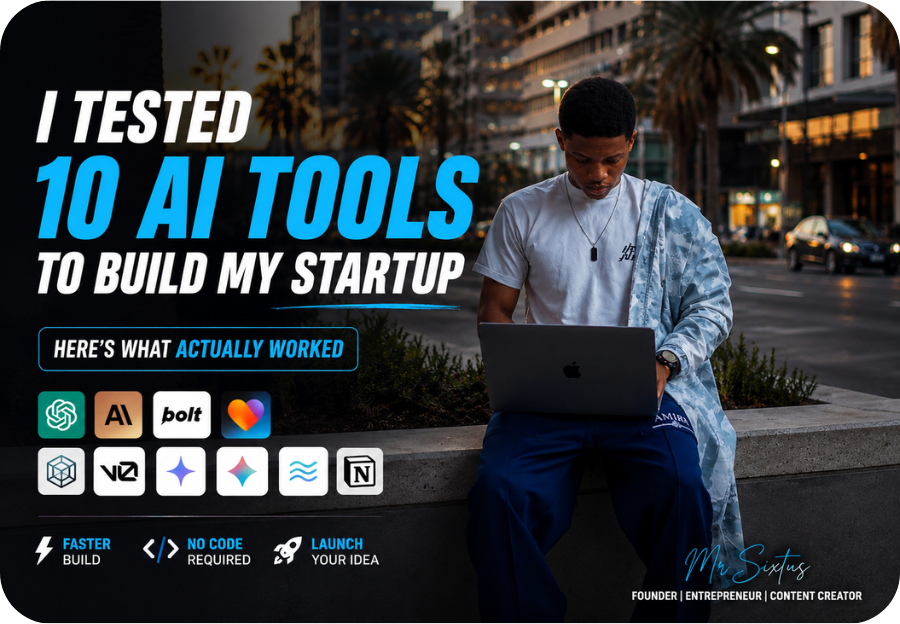
READ ALSO: I Tested 10 AI Tools to Build My Startup — Here’s What Actually Worked (And Why Lovable.dev Won)
9. I Expected Instant Success
Watching AI generate content in seconds created unrealistic expectations.
I believed business growth would happen just as quickly.
It doesn’t.
Business still requires patience.
AI saves time.
It doesn’t eliminate the work.
10. I Treated AI as the CEO
Eventually I realised something simple.
AI should never become the decision maker.
It should become your assistant.
You remain the founder.
You carry the vision.
You understand your customers.
AI simply helps you execute faster.
My AI Learning Journey
          IDEA
            │
            ▼
    AI Generates Everything
            │
            ▼
   No Customer Validation
            │
            ▼
      Poor Product Fit
            │
            ▼
    Low Traffic & Sales
            │
            ▼
      Lessons Learned
            │
            ▼
Customer Research + AI
            │
            ▼
Better Decisions
            │
            ▼
 Sustainable Growth
Comparison Table: Wrong vs Right Way to Use AI
| Mistake | Better Approach |
|---|---|
| Let AI make every decision | Use AI for ideas, make final decisions yourself |
| Publish AI content directly | Edit with personal stories and expertise |
| Skip customer interviews | Validate with real users before building |
| Build every AI suggestion | Focus on solving one major problem |
| Automate everything | Automate only proven workflows |
| Depend on AI predictions | Analyse real business data |
| Ignore branding | Develop a memorable brand identity |
| Expect overnight growth | Focus on long-term consistency |
READ ALSO: 7 Boring But Profitable One-Person Businesses You Can Start With Claude AI
How I Use AI for My Business Today
Today my workflow is completely different.
Instead of asking AI to build my business, I use it to strengthen my decisions.
I use AI to:
- Brainstorm content ideas.
- Improve writing quality.
- Summarise research.
- Generate marketing variations.
- Analyse competitors.
- Organise project plans.
- Speed up repetitive tasks.
- Draft emails and proposals.
- Create content outlines.
- Improve productivity.
Notice something?
AI supports the work.
It doesn’t replace the work.
Key Takeaways
If I could start over, I would remember these principles:
- AI is a tool, not a founder.
- Customers matter more than prompts.
- Authenticity beats perfection.
- Validation is more valuable than automation.
- Speed without direction leads nowhere.
- Human judgment remains your greatest competitive advantage
Final Thoughts
Looking back, I don’t regret using AI.
I regret believing it could replace the hard work of building a business.
The biggest breakthrough came when I stopped asking AI to think for me and started asking it to think with me.
If you’re building your first startup, remember this:
Technology can accelerate your journey, but wisdom still comes from experience, customer feedback, and consistent execution.
Use AI for your Business as your assistant—not your replacement—and you’ll build something far more valuable than software alone.
You’ll build a business people genuinely trust.
Frequently Asked Questions (FAQ)
Is AI good for my business?
Yes. AI can dramatically improve productivity, automate repetitive work, generate ideas, and support marketing efforts. However, it should complement your decision-making rather than replace it.
What is the biggest mistake people make using AI for THEIR business?
The most common mistake is relying on AI for every decision without validating ideas through real customers and real-world data.
Can AI build an entire business?
AI can help create content, business plans, websites, and marketing materials, but it cannot replace customer relationships, leadership, creativity, or strategic decision-making.
Should entrepreneurs trust AI-generated business advice?
AI-generated advice should be treated as a starting point. Always verify recommendations using research, analytics, customer feedback, and your own judgment.
Does Google penalise AI-generated content?
Google focuses on content quality rather than how it is created. Helpful, accurate, original, and people-first content can perform well in search results regardless of whether AI assisted in its creation.