YouTube automation sounds simple when you see it explained online.
Find a niche. Use AI to create the videos. Upload consistently. Get views. Build an audience. Repeat.
But after actually trying to build a channel around AI video creation, I’ve realized that the reality is a lot more complicated and, honestly, more interesting.
I decided to document my own experience with this on my YouTube channel, Mr Sixtus, where I’m experimenting with cinematic AI videos and trying to figure out what one person can realistically accomplish with today’s AI tools.
This isn’t a story about how I made thousands of dollars from YouTube.
I’m still building.
Instead, this is a case study of what I’m learning while doing it myself.
Why I Started the Channel
I’ve been interested in AI video generation because of how quickly the technology has improved.
Not long ago, creating a cinematic scene could require cameras, actors, locations, lighting equipment, visual effects and an entire production team.
Now, a solo creator can generate characters, environments, camera movements and entire scenes with AI.
That doesn’t mean making a good video has suddenly become easy.
It just means the barriers have changed.
That’s what I wanted to test.
Rather than simply talking about AI video tools, I wanted to actually use them to build something people could watch. So I started experimenting with cinematic videos on my own channel.
The idea is simple: use AI to make visually interesting videos while I learn what actually works on YouTube.
And I’m treating the channel as an experiment.
Every upload gives me another opportunity to learn something about the production process, thumbnails, titles, audience behavior and the difference between something that looks impressive and something people actually want to watch.
SEE ALSO: My Entrepreneur Journey: The Late Nights, Hard Lessons, and Success Stories That Changed My Life
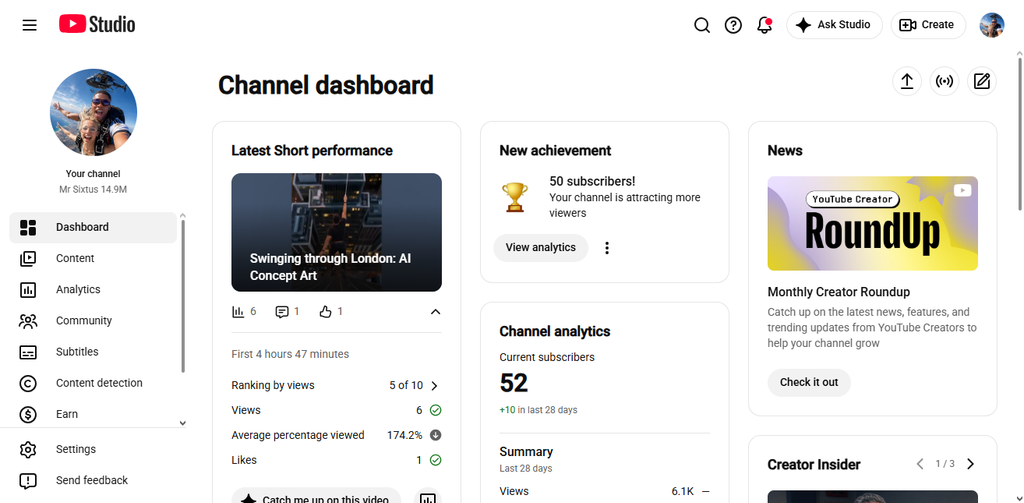
My Channel Is Still Very Small – and That’s the Point
One thing I want to make clear is that I’m not presenting Mr Sixtus as a huge successful YouTube automation channel.
It’s still small.
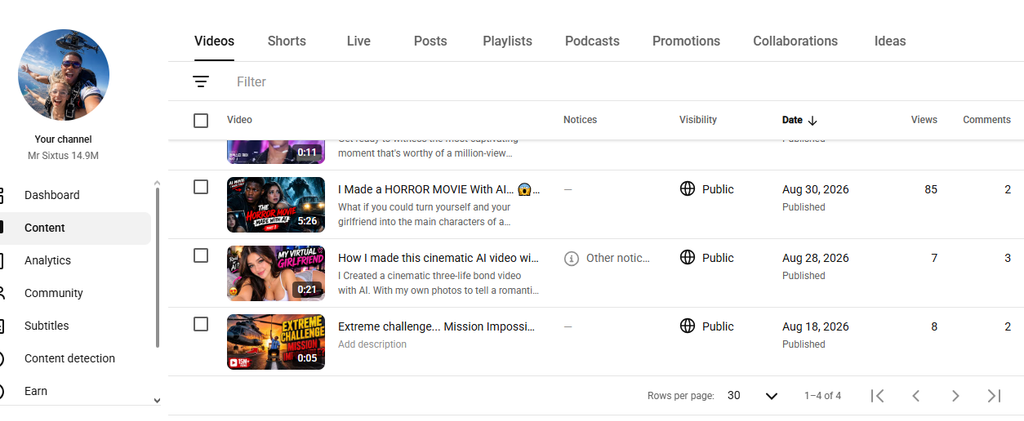
At the time of writing, the channel has only a few published videos, and I’m still figuring out the format and direction.
Over the last 28 days, the channel generated 6,143 views, 8.8 hours of watch time and 10 new subscribers.
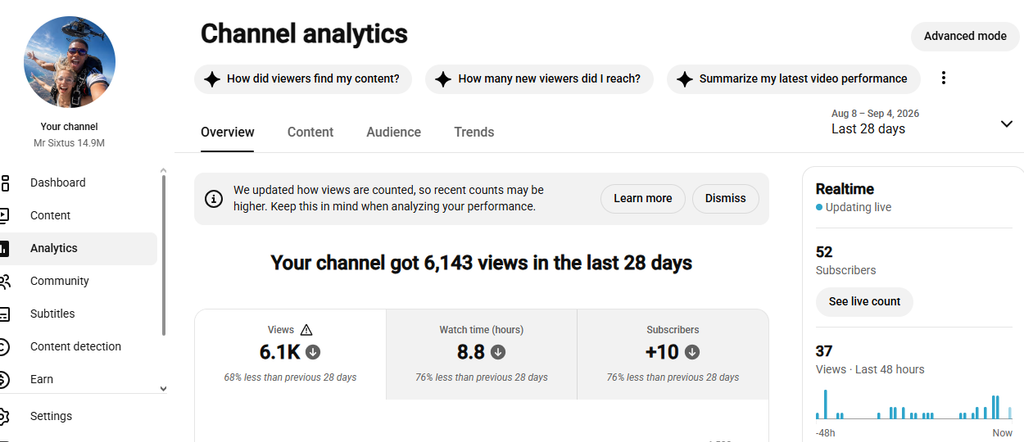
Those numbers aren’t extraordinary, but I’m actually more interested in them because they represent the beginning of an experiment.
I can look at what happened, make changes, upload another video and see whether those changes make a difference.
That’s much more useful to me than simply copying someone else’s YouTube automation strategy.
I’m trying to find out what works for my content, my audience and my production process.
What Creating Cinematic AI Videos Has Taught Me
The biggest surprise so far is that AI doesn’t remove the creative work.
It changes where the work happens.
For example, generating a cinematic-looking scene might only take a few minutes. But getting the scene to look the way I actually want can take considerably longer.
A character might look different from one shot to another.
The camera movement might not feel natural.
An action sequence might look impressive but make no sense within the story.
Sometimes the AI generates something completely different from what I imagined.
So I’ve learned that simply having access to powerful AI tools isn’t enough.
You still need to know what you’re trying to create.
My workflow generally starts with an idea. I then develop the concept, think about the scenes, generate the visuals and bring everything together through editing.
The process is still evolving, and I’m experimenting with different tools and techniques as I go.
That’s one of the reasons I like documenting this publicly. My workflow today probably won’t be the same six months from now.
I’m Starting to See Automation Differently
Before doing this, I thought of automation mainly as a way to reduce the amount of work involved in running a YouTube channel.
Now I see it differently.
For me, automation isn’t about pressing a button and allowing AI to run the entire channel.
It’s about removing repetitive work so I can spend more time on the parts that actually require creativity and judgment.
AI can help generate visuals.
It can help with ideas.
It can speed up certain parts of production.
But I still have to decide whether an idea is worth making, whether a scene looks right, whether the story makes sense and whether the finished video is something I’d personally want to watch.
And YouTube still has the final vote.
The audience decides.
My workflow: Elevate Your videos with our AI prompts.
What I’m Watching Closely
One mistake I don’t want to make is judging the channel only by how good my videos look.
A video can look incredible and still receive very little attention.
A thumbnail can look great but fail to make someone click.
And a video can get clicks but lose viewers quickly if the content doesn’t deliver what the title and thumbnail promised.
That’s why I’m paying attention to the actual analytics as I build.
I’m looking at things like views, impressions, click-through rate, watch time, audience retention and subscriber growth.
For example, seeing how my first videos perform gives me clues about what I should test next.
I’m not expecting every upload to succeed.
In fact, I think some of the most useful lessons will probably come from the videos that don’t perform well.
What I Would Do Differently
If I were starting the channel again, I would spend more time establishing a clear format and production system before creating multiple videos.
I’d want to have a repeatable process for coming up with ideas, developing the story, generating consistent characters and scenes, editing the video, creating the thumbnail and then reviewing the analytics after publishing.
The goal isn’t to make every video identical.
It’s to make the process more efficient.
That’s where I think AI has the biggest opportunity for a solo creator.
Instead of needing five or ten people to handle different parts of production, one person can potentially handle much more of the process with the help of AI.
But “potentially” is the important word.
I’m still testing it.
READ ALSO: Best AI Prompts for Business: My 10 Killer AI Prompts Every Entrepreneur Should Save
So, Does YouTube Automation Actually Work?
I don’t think I have enough data yet to give a definitive answer.
And I’m okay with that.
I’m much more interested in documenting the journey than pretending I already know the outcome.
What I do know is that AI has made cinematic video production much more accessible to an individual creator. The technology can help me experiment with ideas that would have been far more difficult to produce traditionally.
But AI hasn’t made YouTube automatic.
It hasn’t removed the need for good ideas.
It hasn’t guaranteed views.
And it certainly hasn’t replaced the need to understand an audience.
For me, YouTube automation is becoming less about building a channel that runs without me and more about building a system that allows me to create more without doing everything manually.
That’s the experiment I’m running with Mr Sixtus.
I’m going to keep testing different approaches, studying the analytics, improving my production process and learning from both the videos that perform and the ones that don’t.
Maybe the channel will grow faster than I expect.
Maybe I’ll completely change the format.
Maybe some of my current assumptions will turn out to be wrong.
That’s part of the process.
I’m not writing this after reaching the finish line. I’m writing it while I’m still running the experiment.
And as the channel grows, I’ll keep updating what I’m learning.