Artificial intelligence has completely transformed the way people write. Whether you’re a blogger, copywriter, student, marketer, entrepreneur, journalist, or business owner, AI writing assistants can help you produce content faster and more efficiently than ever before.
Among all AI writing tools available today, two names dominate the conversation: Claude AI and ChatGPT.
Both platforms are powerful, intelligent, and capable of generating high-quality content. But when it comes to writing articles, blog posts, emails, social media content, books, and marketing copy, which one actually performs better?
In this comprehensive comparison, we’ll test Claude AI and ChatGPT across multiple writing categories, compare outputs, share real prompts, and help you decide which AI assistant deserves your investment in 2026.
What is Claude AI?
Anthropic created Claude AI as a next-generation AI assistant focused on safety, reasoning, long-form content creation, and natural conversations.
Claude has become especially popular among writers because of its ability to:
- Write naturally
- Maintain context in long documents
- Understand complex instructions
- Produce human-like text
- Generate thoughtful explanations
Many users describe Claude as sounding more “human” and less robotic than traditional AI tools.
What is ChatGPT?
ChatGPT is developed by OpenAI and remains the world’s most widely used AI assistant.
Since its launch, ChatGPT has evolved from a simple chatbot into a powerful writing, coding, research, marketing, and productivity platform.
ChatGPT excels at:
- Content creation
- SEO writing
- Copywriting
- Brainstorming
- Research assistance
- Prompt customization
- Multi-format content generation
With GPT-5.5 powering modern ChatGPT experiences, users can generate highly detailed and context-aware content across virtually every niche.
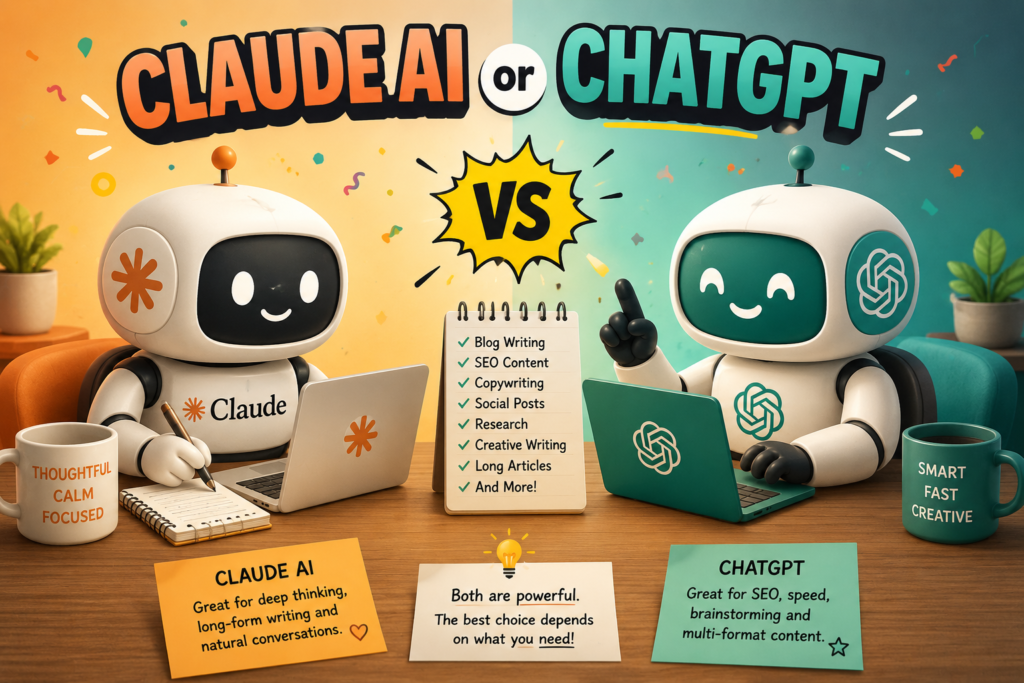
Claude AI vs ChatGPT: Quick Comparison
| Feature | Claude AI | ChatGPT |
|---|---|---|
| Blog Writing | Excellent | Excellent |
| SEO Content | Good | Outstanding |
| Human-Like Tone | Excellent | Very Good |
| Marketing Copy | Good | Excellent |
| Long Documents | Outstanding | Excellent |
| Research Assistance | Good | Excellent |
| Creative Writing | Excellent | Excellent |
| Prompt Following | Excellent | Excellent |
| Customization | Moderate | Outstanding |
| Business Writing | Excellent | Excellent |
Winner:
For general writing, both are excellent.
For SEO, marketing, and content publishing, ChatGPT has a slight advantage.
For highly natural long-form writing, Claude often shines.
Test 1: Blog Writing
Prompt:
Write a 1,000-word blog post about remote work productivity.
Claude’s Output
Claude tends to write:
- More conversationally
- More naturally
- Less promotional
- More reflective
Readers often feel Claude-generated content resembles a professional human writer.
ChatGPT’s Output
ChatGPT tends to write:
- More structured
- Better optimized for SEO
- Stronger headings
- Better readability formatting
- Stronger call-to-actions
For publishers trying to rank on Google, this structure can be a significant advantage.
Winner
ChatGPT for SEO blogs.
Claude for editorial-style articles.
Test 2: SEO Article Writing
Prompt:
Write an SEO article targeting the keyword “best electric cars in 2026”.
Claude
Claude writes informative content but sometimes doesn’t naturally optimize keyword placement.
ChatGPT
ChatGPT generally performs better at:
- Keyword integration
- Search intent matching
- Structured headings
- Featured snippet optimization
- Meta descriptions
Winner
ChatGPT.
If your goal is ranking on search engines, ChatGPT currently has an edge.
Test 3: Human-Like Writing
This is where things become interesting.
Many writers claim Claude sounds more human.
For example:
Claude often writes:
“The reality is that productivity isn’t about squeezing more hours from your day. It’s about aligning your energy with meaningful work.”
ChatGPT may write:
“Productivity involves optimizing workflows, reducing distractions, and implementing effective time management strategies.”
Both are correct.
However, Claude often feels more like a thoughtful essayist.
Winner
Claude AI.
Test 4: Sales Copy Writing
Prompt:
Write a landing page selling a productivity app.
Claude
Produces persuasive but subtle copy.
ChatGPT
Produces:
- Stronger headlines
- Better emotional triggers
- Better CTAs
- Better conversion-focused structure
Winner
ChatGPT.
Marketing professionals generally prefer ChatGPT for conversion copy.
Test 5: Social Media Content
Prompt:
Create 10 viral LinkedIn posts about entrepreneurship.
Claude
Creates thoughtful and insightful posts.
ChatGPT
Creates:
- Better hooks
- More engagement-driven formats
- Better storytelling frameworks
- More platform-specific content
Winner
ChatGPT.
Test 6: Book Writing
Prompt:
Write a chapter for a self-help book about discipline.
Claude
This is one of Claude’s strongest categories.
Claude often generates:
- Deeper reflections
- Better transitions
- Stronger narrative flow
- More emotional intelligence
ChatGPT
Still excellent, but sometimes more structured than emotional.
Winner
Claude AI.
Writing Prompt Examples for Claude AI
Blog Writing Prompt
Act as an experienced journalist. Write a 1,500-word article about remote work productivity. Use a conversational tone, include practical examples, and avoid robotic language.
Book Writing Prompt
Act as a bestselling author. Write a book chapter on discipline using storytelling, real-world examples, and motivational insights.
Newsletter Prompt
Write a weekly newsletter for startup founders. Use a friendly and intelligent tone with actionable advice.
Writing Prompt Examples for ChatGPT
SEO Blog Prompt
Act as an SEO expert. Write a 2,000-word article targeting the keyword “best AI tools for business”. Include an optimized title, H2 headings, FAQs, meta description, and conclusion.
Sales Page Prompt
Act as a direct-response copywriter. Create a high-converting landing page for a productivity software product. Include a compelling headline, benefits, testimonials, objections, and CTA.
LinkedIn Prompt
Create 10 viral LinkedIn posts for entrepreneurs. Each post should start with a strong hook, tell a short story, and end with a question that drives engagement.
Pricing Comparison
Both platforms offer free plans and premium subscriptions.
Claude’s premium plans focus heavily on larger context windows and extensive document handling.
ChatGPT premium plans provide access to advanced AI models, research tools, image generation, content creation features, and broader productivity capabilities.
Pricing may change over time, so always check the official websites before subscribing.
See Also: Must-Use Smartphones of 2026: The Best Upcoming & Recently Launched Phones Worth Buying This Year
Which AI is Better for Bloggers?
If your goal is:
Rank on Google
Choose ChatGPT.
Write Human-Sounding Articles
Choose Claude.
Build a Content Website
Choose ChatGPT.
Write Books
Choose Claude.
Write Marketing Copy
Choose ChatGPT.
Research Topics
Choose ChatGPT.
Long Document Analysis
Choose Claude.
The Best Strategy: Use Both
Many professional writers in 2026 don’t choose one over the other.
Instead, they use both strategically.
A common workflow looks like this:
- Research with ChatGPT
- Create article outlines with ChatGPT
- Draft content with Claude
- Optimize for SEO with ChatGPT
- Final human editing
This combination often produces higher-quality content than relying on either tool alone.
Final Verdict: Claude AI vs ChatGPT for Writing
The answer depends on what type of writing you do.
If you’re a blogger, marketer, SEO specialist, affiliate publisher, or content creator focused on traffic and conversions, ChatGPT remains one of the strongest AI writing tools available.
If you’re a novelist, essayist, author, or writer who prioritizes natural language and deep narrative flow, Claude AI is an exceptional choice.
Overall Winner for Writing in 2026
🏆 ChatGPT wins for SEO content, marketing, business writing, and content publishing.
🏆 Claude AI wins for long-form storytelling, book writing, and human-like prose.
For serious content creators, using both together provides the best results and gives you the strengths of each platform in a single workflow.