In a startup world obsessed with software, apps, and venture backed technology companies, some of Africa’s most transformative entrepreneurs are quietly building something far more tangible factories.
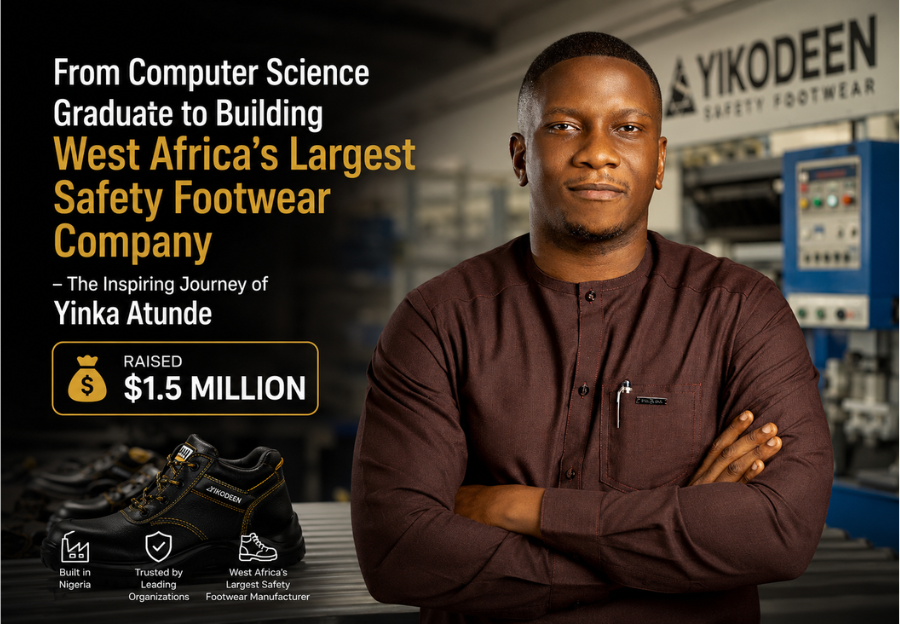
One of those entrepreneurs is Yinka Atunde, the founder of Yikodeen, a Nigerian manufacturing company that has grown from a bold idea into what is now recognized as West Africa’s largest safety footwear manufacturer. His journey is not just a story about business growth; it is a lesson in resilience, vision, and the power of betting on industries that others overlook.
The Unlikely Beginning
Like many young Nigerian graduates, Yinka Atunde appeared destined for a career in technology. Armed with a Computer Science degree from Babcock University, he followed a path that seemed familiar: consider opportunities abroad, pursue a corporate career, and build a future within the fast-growing tech ecosystem.
But life had other plans.
In 2015, a delay in Nigeria’s National Youth Service Corps (NYSC) program created an unexpected pause in his career journey. For many graduates, such a delay would have been viewed as a setback. For Atunde, it became an opportunity to rethink his future.
Rather than waiting for circumstances to change, he made a decision that surprised almost everyone around him. He sought permission from his parents to spend a year learning shoemaking. What appeared to be a temporary detour would ultimately become the foundation of a manufacturing empire.
See Also: James Dumoulin’s Story: How the School of Hard Knocks Founder Built a Multi-Million Dollar Media Empire Before 25
Seeing Opportunity Where Others Saw Limitations
Entrepreneurship often begins with observation.
As Atunde studied the footwear industry, he noticed something that many had overlooked. Despite Nigeria’s large population and growing economy, the country remained heavily dependent on imported footwear products. Local manufacturing capacity existed, but much of it was underdeveloped and unable to compete at scale.
Instead of accepting the status quo, he became curious.
He traveled to Italy to understand advanced shoemaking techniques and later visited China to study industrial-scale production systems. Rather than immediately launching a business after returning home, he immersed himself in factory operations, working directly on production floors to understand the realities of manufacturing.
That hands-on experience revealed a critical gap in the market.
While many local manufacturers focused on fashion footwear, industrial safety footwear remained largely dominated by imports. It was a market that demanded higher standards, stricter certifications, specialized equipment, and relentless quality control.
Most entrepreneurs saw barriers.
Atunde saw opportunity.
Building a Factory with Forgotten Machines
The dream was clear.
The challenge was capital.
Modern industrial machinery required significant investment, and for a young entrepreneur, purchasing brand-new equipment was simply unrealistic. Many founders would have paused their ambitions at this stage.
Instead, Atunde became resourceful.
Across Nigeria, dozens of abandoned factories stood as reminders of the country’s once-thriving manufacturing sector. Hidden inside many of these facilities were machines that had been left untouched for years.
Atunde embarked on a nationwide search.
He visited more than fifteen defunct footwear factories, acquiring aging equipment that others considered obsolete. Working alongside local engineers, he painstakingly restored and recommissioned these machines, transforming forgotten industrial assets into productive manufacturing tools.
The process was far from glamorous.
Machines broke down. Spare parts were difficult to find. Production challenges emerged constantly.
Yet every repaired machine represented progress.
Those restored assets became the backbone of what would eventually evolve into one of Africa’s most remarkable manufacturing success stories.
See Also: 7 Fastest Countries to Get Permanent Residency in 2026 While Earning $80,000+ as a Skilled Worker
The Battle for Trust
Building a factory was only the first challenge.
Winning customers proved even harder.
For years, large corporations operating in Nigeria preferred imported safety footwear. Many procurement teams believed international products were automatically superior to locally manufactured alternatives.
Yikodeen faced rejection after rejection.
Major contracts remained out of reach. Product testing required time and resources. Certifications demanded investment. Convincing buyers to trust a Nigerian-made product often felt like an uphill battle.
But Atunde refused to compromise.
Instead of cutting corners, Yikodeen focused on continuous improvement. The company invested in product development, testing, customer feedback, and quality assurance. Every rejection became a learning opportunity.
Slowly, perceptions began to change.
The Turning Point
Every founder remembers the breakthrough moment.
For Yikodeen, that moment arrived in 2022 when the company secured approval to supply 10,000 safety shoes to the Nigerian Police Force. The contract represented far more than revenue.
It was validation.
Years of persistence, experimentation, and investment had finally paid off.
The momentum accelerated quickly.
Today, Yikodeen serves dozens of organizations across multiple sectors, including construction, manufacturing, oil and gas, logistics, and public institutions. Its growing client base includes some of Nigeria’s largest organizations and industrial players.
Raising $1.5 Million and Scaling for the Future
As demand increased, a new challenge emerged.
How do you scale manufacturing fast enough to meet market demand?
The answer came in the form of investment.
In 2025, Yikodeen secured $1.5 million in funding from Aruwa Capital Management, providing the capital needed to significantly expand production capacity and strengthen operational capabilities.
The investment fueled the development of a world-class manufacturing facility in Lagos, positioning Yikodeen as a major force in Africa’s industrial ecosystem. The company’s expanded operations now support thousands of pairs of safety footwear production daily while creating hundreds of jobs.
The growth reflects a broader shift occurring across the continent: African manufacturers are increasingly proving that world-class products can be designed, produced, and scaled locally.
More Than a Footwear Company
What makes Yikodeen particularly interesting is that it is no longer simply a footwear business.
The company is evolving into a broader industrial manufacturing platform focused on safety products, personal protective equipment (PPE), and industrial materials. Its vision extends beyond boots and safety shoes toward building a vertically integrated manufacturing ecosystem that serves multiple sectors across Africa.
This strategy addresses one of Africa’s most pressing economic challenges: dependence on imports.
By producing locally, companies like Yikodeen help retain value within African economies, create skilled employment opportunities, strengthen supply chains, and develop industrial expertise that can be exported globally.
See Also: How to Get Hostinger 90% Off in 2026 (Step-by-Step Guide + Free Domain)
Lessons from Yinka Atunde’s Entrepreneurial Journey
Yinka Atunde’s story offers several lessons for entrepreneurs, investors, and policymakers.
First, opportunity often exists in industries that receive little attention. While technology attracts headlines, manufacturing remains one of the most powerful drivers of economic transformation.
Second, constraints can become advantages. Rather than waiting for perfect conditions, Atunde built a company using refurbished machinery and local ingenuity.
Third, trust is earned through consistency. Yikodeen’s success was not driven by a viral moment or overnight growth. It was built through years of quality improvement, persistence, and execution.
Finally, African manufacturing is not a future possibility it is already happening.
The Road Ahead
A decade ago, Yinka Atunde stepped away from the career path many expected him to pursue. Today, that decision stands as a powerful reminder that entrepreneurship is rarely about following conventional routes.
From learning shoemaking during an unexpected career pause to leading one of Africa’s fastest-growing industrial manufacturing companies, his journey demonstrates what becomes possible when vision meets persistence.
As Yikodeen continues expanding its footprint across Africa, the company represents more than a manufacturing success story. It symbolizes a new generation of African founders who are proving that global-quality products can be designed, built, and scaled on the continent.
And it all started with one unconventional decision, to take a chance on making shoes when everyone expected a career in tech.